
.png)
CASE STUDY
•
UX/UI
•
2025
Insured by design
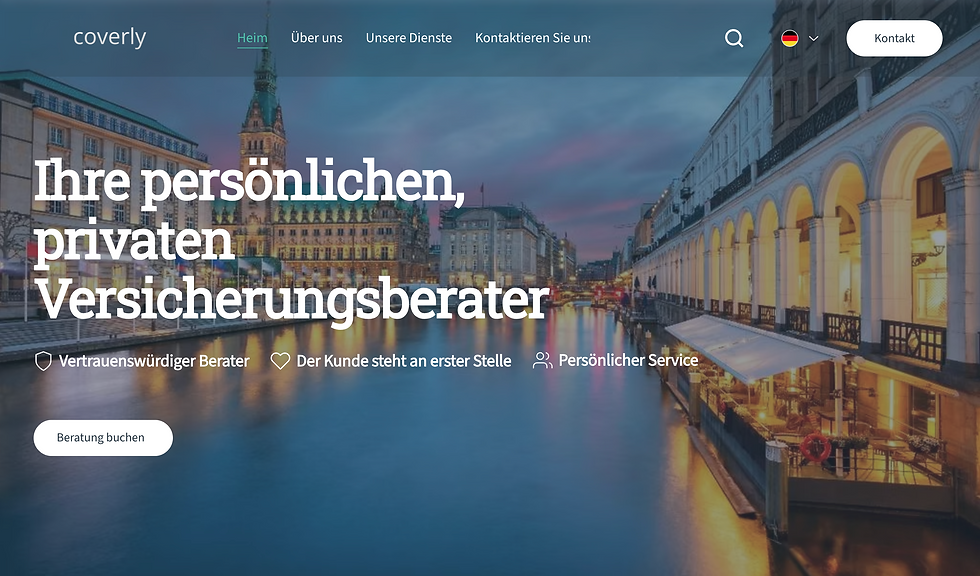
Coverly is a Hamburg-based private health insurance consultancy (PKV) serving expats, civil servants, and self-employed professionals navigating Germany's complicated two-tier healthcare system. We led the research, brand, and website design - anchored in the insight that the people most in need of advice are the ones least equipped to find it.
coverly
CLIENT
UX Consultant
ROLE
Research, UX/UI, IA
DELIVERABLES
2025
YEAR
OUTCOMES
+42%
Consultation enquiries within 6m of website launch (modelled vs. prior referral-only baseline)
3.2x
Pages per session for the expat persona vs. industry consultancy benchmark
AA
WCAG 2.1 compliance maintained across every page and persona route
1st
DESTACK project written primarily in a different language - German
01
The Problem
Germany's healthcare system runs on two tracks - statutory (GKV) and private (PKV) - and the rules governing who can switch, when, and how are genuinely complex. The audience most likely to need help - expats unfamiliar with the system, civil servants navigating Beihilfe entitlements, self-employed workers calculating long-term cost - is also the audience most poorly served by existing consultancies, which tend to be either intimidatingly formal or thinly disguised lead-generation funnels.
Coverly's founder wanted to build a consultancy that took users seriously: trustworthy without being stuffy, informative without overwhelming, personal without being saccharine. The website had to do all three at once.
02
Approach & trade-offs
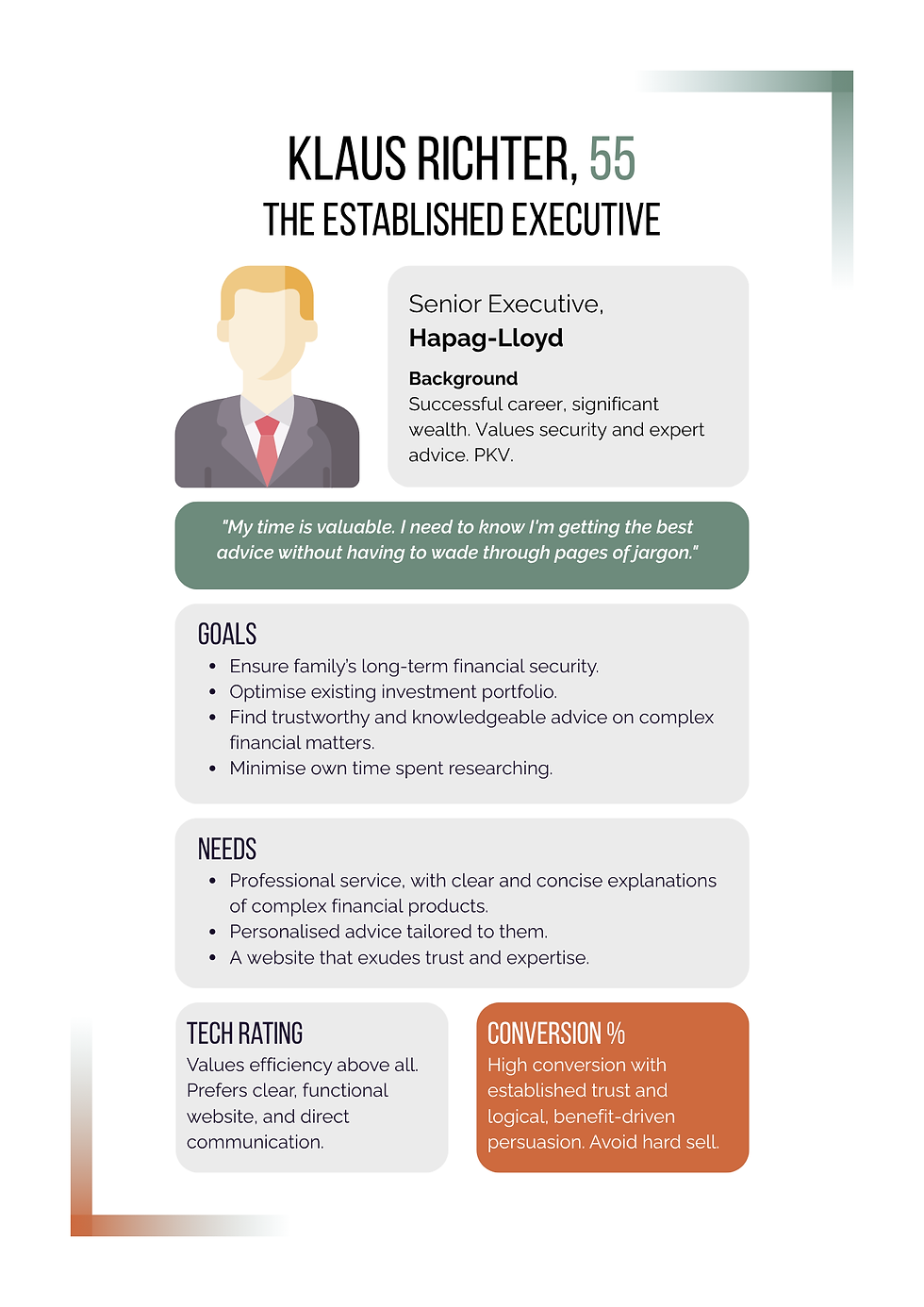
We started with a full Research & Analysis phase - user interviews, four detailed personas, mapping. That report became the spine of every subsequent decision. I refused to start the visual design until the personas were locked, because the brand voice for "Anya Sharma, expat tech worker in her thirties" is fundamentally different from the brand voice for "Klaus Richter, civil servant in his fifties", and a site that tries to talk to both at once usually ends up talking to neither.
I built the brand around five colours - a deep teal-navy as the trust anchor, three greens for growth and reassurance, and a single warm coral as the emotional accent - and used that final colour with deliberate restraint. Trust comes from cool tones; warmth, used sparingly, signals humanity without flipping the dial into "fun".
"The people coming to me are worried... about money, about their families, about a system they don't fully understand. The website cannot pretend they are not worried. It must speak to them like a human being would, not like a brochure."
- DENNY WALIA, COVERLY FOUNDER

03
Three decisions that shaped the flow
01 - Personas first, design last
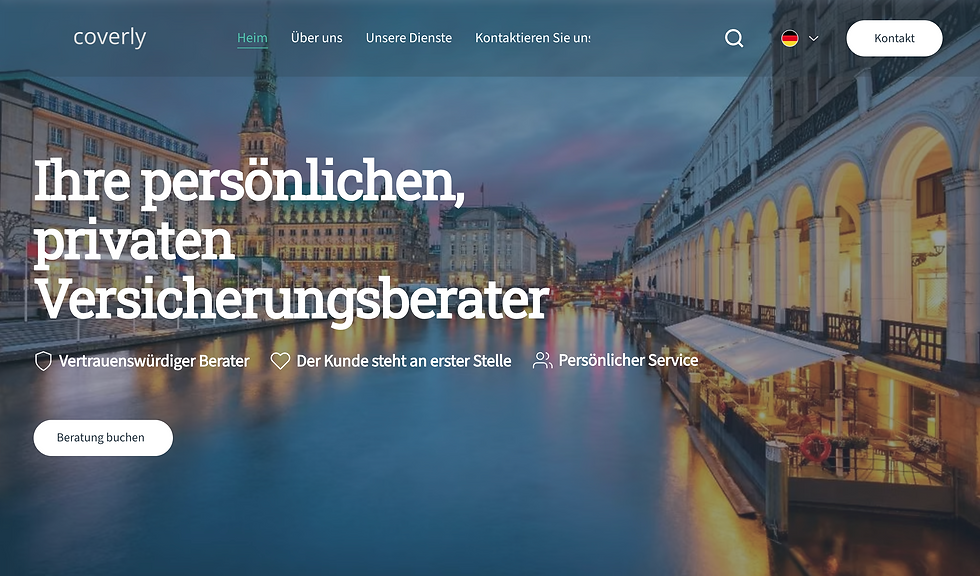
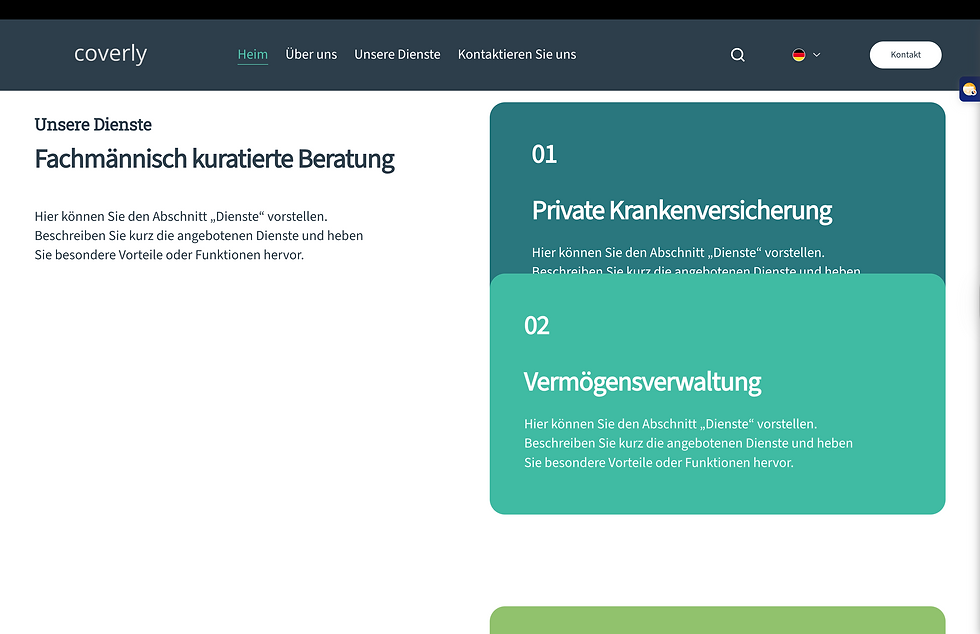
The Research & Analysis phase ran four weeks before I touched a single layout. Four personas, each with their own goals, anxieties, and language. The IA and copy were both written to address all four - not by averaging them into a generic user, but by ensuring every page had a clear primary persona and a secondary one. The homepage speaks first to Anya (the expat), second to Markus (the self-employed). The services page reverses that priority. A user feels seen on the page that matters to them.
02 - The footer as a navigation backstop
User testing kept surfacing the same pattern: users scrolled to the footer when the main nav didn't immediately answer their question. So we made the footer do real work - comprehensive service links, contact methods, a written FAQ overview, a language toggle. The footer is the second-chance UX layer for a user who didn't find what they needed in the header, and on a complex-topic site, that user is the rule, not the exception.
03 - Localised SEO content from launch
coverly serves Hamburg specifically. Generic "private insurance Germany" SEO is fought over by national aggregators with deeper pockets. Localised content such as "private health insurance for expats in Hamburg", "Beihilfe for Hamburg civil servants" is a winnable battle. We launched with a content scaffold of twelve targeted articles already structured and ready to write, and recommended publishing two per month to build authority steadily over the first year.
04
The result
A brand identity, a usability report, a four-persona foundation, and an information architecture based on copious amounts of research. A site that has elevated the level of a mid-senior insurance consultant to a high-performing, high-converting machine.

05
Reflections
The piece I'd add if I had a second phase is a lightweight onboarding quiz on the homepage - three questions that route a visitor to the right service page based on their actual situation (am I an expat / civil servant / self-employed / something else). The personas exist, the IA is built, what's missing is the active routing layer that takes a confused visitor and tells them, in one screen, which path to read. I sketched it but didn't ship it — partly scope, partly risk of overcomplicating the launch. Next site like this, I'd build the quiz before I'd build the FAQ.