
.png)
CASE STUDY
•
MARKETING
•
2023
A fitting website for a fitting company.
Beautiful Bedrooms - a London-based bespoke-furniture company - needed a website that actually generated leads. Not just prettier. Sharper.
Beautiful Bedrooms
CLIENT
Lead Designer
ROLE
UX/UI, Marketing, Email system
DELIVERABLES
2023
YEAR

OUTCOMES
+35%
Site engagement
+50%
Design-visit bookings
52%
Email open rate
+15%
Consultation uplift
01
The Problem
Beautiful Bedrooms had strong reviews, strong craft, strong word-of-mouth - and a website that was actively undermining all three. Cluttered navigation, weak CTAs, inconsistent visual language. The brand's biggest assets - quality and service - were nowhere on the page.
Analytics confirmed it: traffic was healthy, but engagement was thin and conversion was almost non-existent. The site was a brochure for a business that needed a funnel.
02
Approach & trade-offs
Three phases - research & analysis, design, marketing - but the structural call was that this wasn't a redesign project. It was a lead-generation project that happened to need design as the first lever.
"You design the funnel before you design the homepage. The job of the homepage is to feed the funnel - so build the destination first, then build what gets people there."
- JOE SAYERS, LEAD DESIGNER

03
Three decisions that shaped the flow
01 - Top service as a visible product
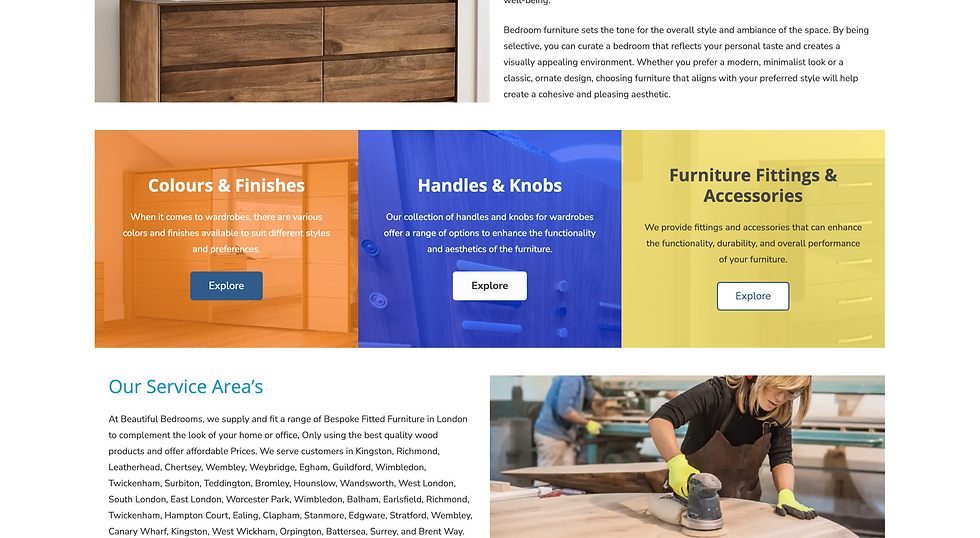
Customer reviews kept naming the same two things: the quality of the build and the quality of the service. Neither was visible on the site. I built service-focused banners and surfaced testimonials directly into the homepage flow rather than burying them on a separate page.
02 - Contact forms where the intent is
Instead of a single contact page, I placed lightweight contact forms on every product page - so a high-intent visitor browsing wardrobes never has to navigate away to ask about wardrobes. That single IA change carried most of the conversion lift.
03 - Email as a second touchpoint, not a campaign
Integrated automated emails for post-enquiry follow-up and design-consultation reminders. Open rates settled at 52% - well above the 21% sector benchmark - because the messages were transactional and timed, not promotional.
04
The result
A cleaner site, a working funnel, and a measurable lift in the metric that actually matters to a bespoke-furniture business: people booking design visits.


.png)
05
Reflections
The redesign worked because we treated marketing as part of the design system, not a layer bolted on at the end. The thing I'd push harder on next time: closing the loop between the design-visit booking and the customer's eventual order. The site delivers the lead. The handoff to the in-person consultation is still the weak link, and a designer should own that handoff explicitly rather than treating it as someone else's problem.